Gated communities and managed apartment complexes have become one of the most preferred forms of property investment in India. With that popularity comes a growing need for every resident — owner or tenant — to understand their apartment resident rights. Knowing these rights helps prevent disputes and ensures a safe, transparent, and harmonious stay in a housing society.
Several courts have settled disputes on this subject over the years, and the legal framework around tenancy and society governance has continued to evolve — most notably with the state-by-state rollout of the Model Tenancy Act and updated cooperative society / RWA governance norms that are now shaping how residents, tenants, and Management Committees interact in 2026.
This blog covers the essential apartment resident rights you should know, along with how recent regulatory changes affect them.
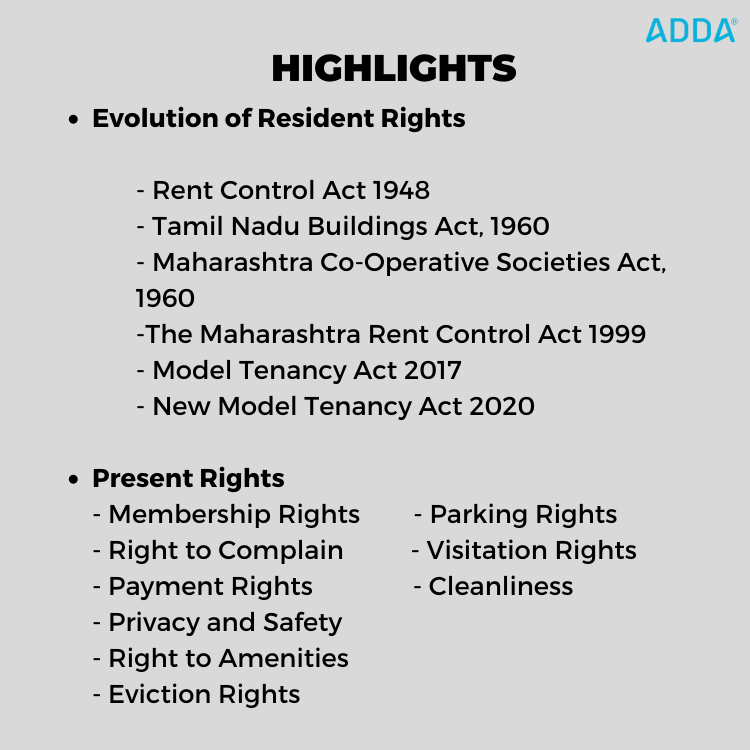
Table of Contents
What Are the Present Apartment Resident Rights
1. Membership Rights
- Every apartment owner is generally required to be a member of the apartment association (RWA, AOA, or Cooperative Housing Society) formed for the welfare of residents.
- In the case of joint ownership, the first person named in the title document is typically recorded as the member.
- Tenants residing in the apartment on a rental basis are usually classified as associate members.
- Residents have the right to access the list of members and the Managing Committee.
- Residents and tenants cannot be discriminated against by members, the association, or other community stakeholders.
- Under most State Cooperative Societies Acts, the society must issue a share certificate to a member within a defined period (commonly six months) of allotment; refusal can be escalated to the Registrar of Cooperative Societies.
2. Payment Rights
- One of the most fundamental apartment resident rights is the right to receive a proper receipt for every deposit, rent, and maintenance payment made.
- Residents can protect this right by digitising bill generation and collection through a society management platform like ADDA, which maintains a transparent, auditable payment trail for all accounting and payment related transactions.
- Maintenance charges collected by a society or association should only be at the rate approved in the Annual General Meeting (AGM) — arbitrary hikes outside this process can be challenged.
3. Privacy and Safety Rights
- A landlord cannot enter a rented premises at will. Under the tenancy rules being adopted across states, a landlord must give the tenant prior notice (commonly 24 hours) and visit only during reasonable hours. Read more about this in our blog on rights and duties of tenants.
- Visitor logs of residents cannot be checked without prior information, except in exceptional circumstances.
- Management Committees cannot bar residents from keeping legal animal companions within their own units.
4. Right to Amenities
- Residents and tenants have the right to invite guests and use common amenities such as the swimming pool, gym, and clubhouse — though associations may require prior intimation for guest use of facilities.
- Associations cannot withhold essential amenities such as water, electricity, waste disposal, or car parking from a resident merely for non-payment of dues; such disputes must go through a proper legal or Registrar-level process, not unilateral disconnection.
- A tenant may use the lifestyle services offered by the society’s management staff, provided all dues owed to the association are cleared.
5. Eviction Rights
- A unit owner cannot be evicted from their own property except through due process of law, and only in cases involving proven gross misconduct, criminal activity, or conduct legally held to be harmful to other residents.
- A landlord or management body may seek eviction of a tenant if the tenant has failed to pay rent for a defined consecutive period (commonly cited as more than two months), has sublet the property without permission, has seriously violated society rules, or if the owner requires the unit for personal use.
- Under the tenancy reforms being rolled out in several states, eviction and rent-dispute matters are increasingly routed through a dedicated Rent Authority or Rent Court rather than regular civil courts, which is intended to speed up resolution. Our blog on discrimination in housing societies covers related issues in more depth.
6. Right to Complain
- An apartment owner cannot impose illegal restrictions on a tenant, such as denying late entry, banning pets, or levying unauthorised charges under false pretext.
- Residents have the right to have their complaints and grievances heard and addressed by the association. In cases of harassment by an owner or management body, a resident may file an FIR, approach the civil court, or file a complaint with the Registrar of Societies.
7. Parking Rights
- Residents are entitled to a parking badge or sticker for their vehicle and must be allotted parking space as per the society’s approved parking policy.
- Residents have the right to park within the society premises, subject to the society’s parking rules. Read more in our blog on rules pertaining to car parking in apartment complexes.
8. Visitation Rights
- Residents and tenants have the right to invite guests, but are also responsible for the conduct of their visitors within the premises.
9. Right to a Clean and Well-Maintained Environment
- Residents and tenants are expected to maintain cleanliness in common areas.
- The Management Committee is responsible for ensuring common premises remain hygienic and that all repairs and maintenance of shared spaces are kept up to date.
10. Right to Transparency and Governance (Updated for 2026)
- Members of a cooperative housing society have the right to inspect society records — accounts, meeting minutes, expenditure records, and contractor bills. “Confidentiality” is not a valid ground to deny this access under most State Cooperative Societies Acts.
- An Annual General Meeting (AGM) must be held at least once a year. If it is not, the Registrar of Cooperative Societies can direct that one be convened, and in serious cases of non-compliance, may take further action against the Managing Committee.
- These transparency norms are increasingly being enforced digitally, with several state Registrar offices and RWAs moving records, notices, and AGM minutes online for easier resident access.
Evolution of Apartment Resident Rights
Housing societies, tenants, residents, and homeowners are governed by a mix of central guidance and state-specific laws that together shape day-to-day apartment management. Every housing society operates under its own bye-laws, framed within the boundaries of the relevant state Act. Apartment resident rights and duties have evolved over decades through multiple legislative amendments and court rulings.
- Rent Control Act, 1948 : An early central law regulating the letting of property, intended to balance the interests of landlords and tenants.
- State Apartment Ownership / Cooperative Societies Acts : Laws such as the Maharashtra Co-operative Societies Act, 1960, the Karnataka Apartment Ownership Act, 1972, the Tamil Nadu Apartment Ownership Act, 1994, and similar state legislation define registration, membership, governance, and the duties and privileges of housing societies and associations in their respective states.
- RERA, 2016 : The Real Estate (Regulation and Development) Act requires builders of RERA-registered projects to facilitate the formation of a resident association after handover, and continues to shape builder–resident obligations.
- Model Tenancy Act, 2021 : Approved by the Union Cabinet as a model framework for states and union territories to adopt or adapt, the Act aims to formalise rental housing, reduce disputes between landlords and tenants, and set up a faster dispute-resolution mechanism.
Where the Model Tenancy Act Stands in 2026
It’s important to know that the Model Tenancy Act is not a single nationwide law — since land and tenancy are state subjects, each state decides whether, and how, to adopt it. As of 2026:
- States broadly fall into three categories: those with frameworks closely aligned to the Act and stronger documentation and dispute-resolution systems, those in transition with a hybrid of old and new rules, and those still relying on traditional rent-control systems.
- Several states have moved to align their local tenancy rules with the Model Tenancy Act framework, and many of the adopting states are setting up a dedicated Rent Authority in each district to handle tenancy disputes faster than regular civil courts.
- In states that have adopted an MTA-aligned framework, common features include a written, digitally registered rent agreement (commonly required within 60 days of signing), a capped security deposit (frequently limited to around two months’ rent for residential property), and restrictions on the frequency of rent increases, usually once a year with proper notice.
- Residents should always check their own state’s specific rules, since implementation timelines and details vary widely some states have notified rules, others are still reviewing them.
Apartment owners who lease out their units, and tenants renting a home, should check whether their state has adopted or adapted the Model Tenancy Act, and rely on the applicable state rent law or rent-control act where it hasn’t.
FAQs on Apartment Resident Rights
1. What are apartment resident rights?
Apartment resident rights are the legal protections and entitlements available to owners, tenants, and associate members of a housing society — covering areas such as membership, payment receipts, privacy, use of amenities, parking, complaint redressal, and protection from unlawful eviction or restrictions.
2. Is the Model Tenancy Act applicable across all of India in 2026?
No. The Model Tenancy Act is a model framework circulated by the central government; it only applies in states that have formally adopted or adapted it into their own tenancy laws. States that haven’t adopted it continue to follow their existing rent-control or tenancy laws.
3. Can a Management Committee cut off water or electricity for non-payment of maintenance dues?
Associations generally cannot arbitrarily disconnect essential amenities like water, electricity, or waste disposal over unpaid dues. Recovery of dues is expected to follow the proper legal or Registrar-level process rather than unilateral action.
4. Can a landlord evict a tenant without going to court?
No. Eviction typically requires legal grounds such as non-payment of rent for a defined period, unauthorised subletting, or serious violation of society rules and must be upheld through the appropriate legal forum, which in several states is now a dedicated Rent Authority or Rent Court rather than a regular civil court.
5. Do tenants have a right to receive rent and maintenance receipts?
Yes. Receiving a proper receipt for every rent, deposit, and maintenance payment is one of the most basic apartment resident rights. Digitising these processes through a society management platform makes this easier to enforce and track.
6. Can a society deny a resident’s right to keep a pet?
No. Management Committees cannot bar residents from keeping legal animal companions in their own units, subject to reasonable society rules around common-area conduct.
7. What can a resident do if their complaint isn’t addressed by the association?
A resident has the right to have grievances heard and resolved. If the association or management fails to act, or if the resident faces harassment, they can file a complaint with the Registrar of Societies, approach the civil court, or in appropriate cases file an FIR.
8. Are digital rent agreements now mandatory?
In states that have adopted an MTA-aligned framework, written rental agreements are commonly required to be digitally registered with the Rent Authority within a set period (often 60 days) for the agreement to be legally enforceable. This is not yet uniform across India, so residents should check their specific state’s rules.
9. Can a resident inspect their housing society’s financial records?
Yes. Members of a cooperative housing society generally have the right to inspect accounts, meeting minutes, expenditure records, and contractor bills. The society cannot deny this access on grounds of confidentiality.
10. Where can residents check their exact rights and obligations?
Every society operates under its own bye-laws, framed under the relevant state Act (Cooperative Societies Act, Apartment Ownership Act, or Societies Registration Act, depending on the state and structure). Residents should review their society’s bye-laws and their state’s current tenancy or cooperative society rules for the most accurate, up-to-date position.