If you are reading this, chances are that you have recently moved into a housing society, or are planning to. Or perhaps you’re a newly appointed management committee member looking to brush up on the basics. Either way, we’ve got you covered. This blog covers everything you need to know about housing society management — the key segments, who’s responsible for them, the rules that govern it, and what’s changed heading into 2026.
If you are a new Management Committee, click here to download The New MC Guide Kit.
Here’s the Best Housing Society Software To Look At
Table of Contents
What are housing societies and why do we need to manage them?
What Are Housing Societies, and Why Do We Need to Manage Them?
A housing society is an organization owned and operated by its members, primarily to meet the residential needs of a community by managing shared housing and accommodation. Members with common interests come together and register a legally established society to improve their living conditions and collectively meet their needs. Co-operative housing societies are defined by democratic control — regular meetings and elections for management committee members are core to how they function.
Members contribute economically, either monthly, quarterly, or yearly, and cooperate on various community matters. Membership is voluntary, and the rules and regulations are laid down by each state’s own bye-law framework governing housing societies in that state. It’s no surprise, then, that societies need dedicated housing society management systems. In today’s tech-savvy world, a society management app like ADDA provides a single, consolidated way to manage all these moving parts.
Top Features of Housing Society Management Software
Major segments of housing society management
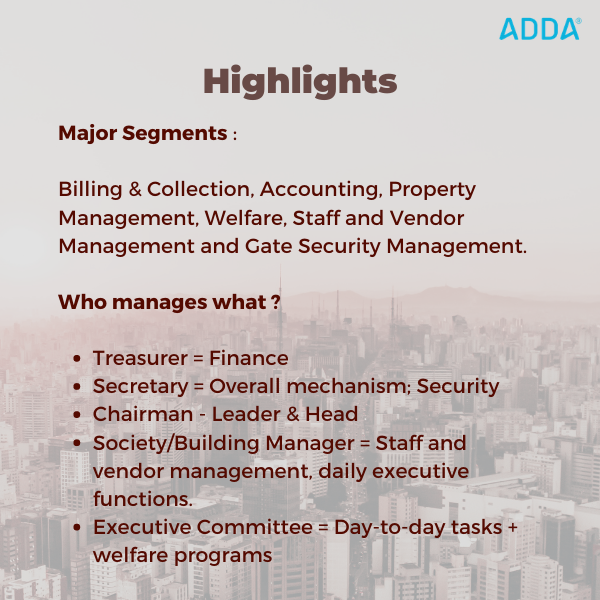
There are several segments that need active management in a housing society. The following are the most common across housing society management systems:
- Finance: Since a housing society is non-profit, the bulk of its income comes from resident maintenance payments. Finance covers more than collection — it includes journal entries, expense and transaction record-keeping, tax payments, annual report presentation, timely audits, and budgeting.
- Maintenance and Upkeep of Infrastructure: Regular repair, asset maintenance, and necessary construction work within a society complex ensures amenities stay functional and residents aren’t inconvenienced for long.
- Property Management: With hundreds of flats and multiple buildings under a single management committee, renting, selling, and buying of apartments needs its own dedicated management segment.
- Welfare: This segment covers the socio-cultural needs of residents — festival celebrations, events, trips, talks, and workshops — upholding a sense of community.
- Staff and Vendor Management: Delivery, cleaning, repair, pest control, and other vendor and staff services need smooth entry/exit tracking, whether contracted directly by the society or outsourced. A society management app like ADDA makes this considerably easier.
- Gate Security Management: Safety and security remain a top priority for any well-run society. Today’s expectations go well beyond a manual register — see the 2026 update below on how gate security has evolved with smart access technology. Read more in our blog on The Best Gate Management System.
Not Using ADDA Yet? Find Out What You’re Missing
Who takes care of these segments?
Every housing society has a management committee whose members — individually or together — are responsible for managing each of the segments above.
- Treasurer: Handles all finance-related tasks — presenting the annual budget, formulating savings plans, and maintaining detailed records of financial expenses and transactions. The treasurer also liaises with the society’s appointed auditor and monitors funds and dues. Digital account and monetary management tools like ADDA are a treasurer’s best friend for cutting down manual work and errors. Read more in this blog on society billing and accounting.
- Secretary: Drives the overall mechanism of housing society management — organizing and coordinating management committee and general body meetings, setting agendas, taking minutes, and sharing them with attendees. The secretary also handles resident complaints and grievances, bringing them before the management committee, and works with the treasurer and executive committee on resident welfare.
- Chairman/President: Leads the management committee, represents the society in legal matters, and is answerable to the relevant authorities. The Chairman has the final say on decisions, presides over society meetings, and ensures the society’s goals and needs are met.
- Society Manager/Building Manager: Executes repairs and welfare functions on the secretary’s instructions, handles Staff and Vendor Management, and supports the management committee in property management.
- Executive Committee: Alongside the Chairman, Treasurer, and Secretary, executive committee members help execute day-to-day functions and implement welfare programs for residents.
- Security: Responsible for visitor check-in/check-out, CCTV and security equipment monitoring, incident reporting, and coordination with the management committee — and, when required, with law enforcement.
Solve Your Society Issues — Talk to Our Product Specialist
What are the rules of housing society management?
Every housing society has certain rules and regulations that members and residents must follow. In India, societies operate under state-implemented bye-laws that form the backbone of ethical, disciplined management. Bye-laws are flexible and can be amended over time.
- As a society member, you’re entitled to approach the management committee and ask to see the account books. The society cannot legally refuse to reveal the annual balance sheet.
- A digital accounting system, like ADDA, helps maintain cashless transactions and supports a sustainable, efficient accounting process.
- Under the Society Bye-Laws (commonly No. 46 and 47 in the Maharashtra model bye-laws), every member must keep the premises around their flat clean. Members may make alterations or additions to their flat with prior committee permission, and must allow the secretary and other MC members to inspect the flat for repairs carried out at the society’s cost.
- If a background check reveals a prospective resident’s criminal history, the society can refuse membership (for renting or buying). However, no society can refuse membership on the basis of religion, caste, race, ethnicity, or gender. Read more on what constitutes discrimination here.
- Every housing society will have clear rules for the gated community. Besides society-appointed security guards, residents often act as an informal backup layer for one another. Parking spaces are meant to be shared and allotted equitably among residents — and, as covered below, this allotment process itself has recently been tightened in some states.
You can always refer to your society’s bye-laws booklet for the specific rules that apply to your community.
2026 Update: What’s Changed in Housing Society Management
A few developments are reshaping how societies are run in 2026 — worth knowing whether you’re a resident or an MC member:
- Maharashtra’s new statutory framework for housing societies. The Maharashtra Co-operative Societies (Amendment) Rules, 2026 introduced a dedicated Chapter XI-B specifically for co-operative housing societies — the first framework of its kind, separate from general co-op society rules. It brings uniform service charges, a cap on non-occupancy charges (up to 10% of service charges), a cap on interest for delayed maintenance payments (up to 12% per annum), and — notably for the “rules” above — a requirement that parking allotment now be decided by the General Body rather than left purely to Managing Committee discretion. It also formally permits video conferencing for general body and redevelopment meetings, making participation far easier for NRI members and senior citizens.
- Smarter gate security is now the norm, not a luxury. The “Gate Security Management” segment has moved well past manual visitor logs. Automatic Number Plate Recognition (ANPR) cameras now let verified resident and staff vehicles pass through boom barriers without stopping, while automating visitor and delivery entry logging — reducing both wait times and the scope for manual error at the gate.
- EV charging has become a management responsibility, not an edge case. With EV ownership rising fast, gate security, parking allotment, and infrastructure maintenance segments increasingly need a clear, written policy for resident EV charger requests — including approval timelines and fire/electrical safety sign-off — rather than handling each request ad hoc.
- Helpdesk and complaint resolution are getting automated. Many societies are now using automated first-response tools for resident helpdesks, so routine complaints (maintenance requests, visitor issues, amenity bookings) get acknowledged and routed instantly instead of waiting on a committee member to notice and respond.
- Digital registration and record-keeping. New societies (in states like Maharashtra) are increasingly required to use digital forms for registration, name reservation, and bank account approvals — part of a broader shift toward paperless, Registrar-facing processes.
What this means in practice: the core segments of housing society management — finance, maintenance, property, welfare, staff/vendor management, and gate security — haven’t changed. What’s changed is the expectation that each of these segments now runs on clearer, more transparent, and increasingly digital processes, with less room for informal or committee-only decision-making on matters like parking, charges, and meeting participation.
FAQs on Housing Society Management
1. What is housing society management?
Housing society management refers to the administration of a residential community’s shared affairs — finance, maintenance, property matters, resident welfare, staff/vendor coordination, and gate security — typically carried out by an elected Management Committee under the society’s bye-laws.
2. Who is responsible for managing a housing society?
The Management Committee, comprising the Chairman/President, Secretary, Treasurer, and Executive Committee members, is collectively responsible, with day-to-day execution often supported by a Society/Building Manager and security staff.
3. Can a resident ask to see the society’s financial records?
Yes. Members have the right to inspect the account books, and the society cannot legally refuse to share the annual balance sheet.
4. Has the process for parking allotment changed recently?
In Maharashtra, yes — under the 2026 amendment rules, parking allotment is now expected to be decided by the General Body rather than the Managing Committee alone, aimed at reducing disputes and improving transparency. Rules in other states may differ.
5. Can a society refuse membership to a prospective resident?
A society can refuse membership based on a documented criminal background check, but cannot refuse membership on the basis of religion, caste, race, ethnicity, or gender — doing so would constitute discrimination.
6. What role does technology play in modern housing society management?
Increasingly central — digital accounting for transparent, cashless transactions; ANPR-based gate access for faster, more secure entry; automated helpdesk tools for faster complaint resolution; and digital registration processes with the Registrar are all becoming standard rather than optional.
7. Are housing society meetings now allowed to be conducted online?
In Maharashtra, video conferencing is now formally permitted for general body and redevelopment meetings under the 2026 rules, making it easier for members who can’t attend in person to participate directly.
8. Where can I find the exact rules that apply to my society?
Your society’s own bye-laws booklet is the primary reference, since it’s framed under your state’s specific Cooperative Societies Act or Apartment Ownership Act — always check for the latest version, as several states have updated their rules recently.
Housing society management is easier than ever with an online platform like ADDA, which brings all of these segments — finance, maintenance, welfare, staff/vendor management, and gate security — into a single, consolidated system. Contact us to know more.
This article reflects the regulatory and technology landscape as it stands in 2026. Rules vary by state and continue to evolve — always verify the current requirements applicable to your specific society and state.