Table of Contents
Are Amenities Alone Enough to Create a Great Residential Community?
When people first visit a residential community, they usually notice the obvious things first.
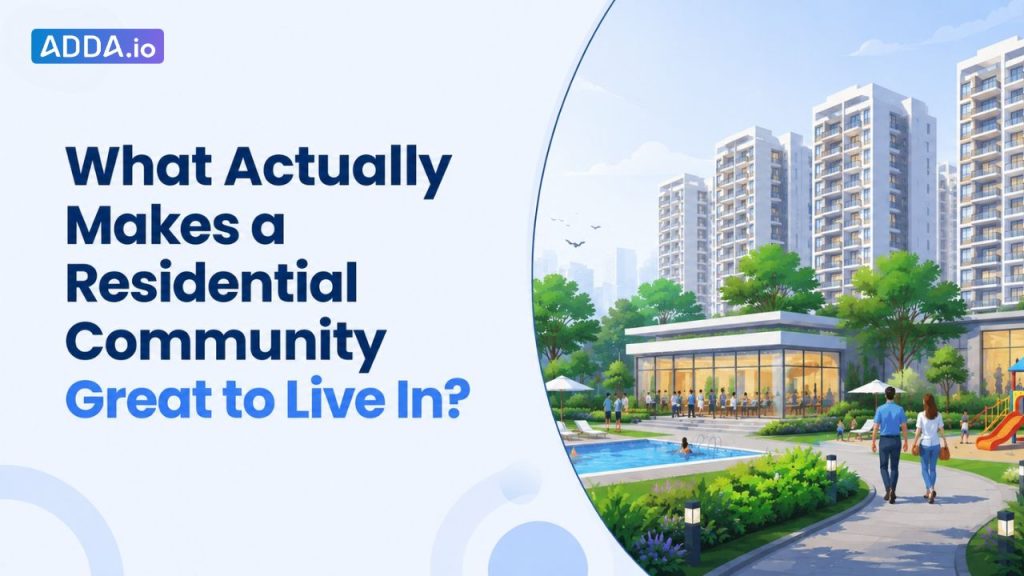
The clubhouse. The swimming pool. The landscaped gardens. The gym. The children’s play area. The tall buildings and modern infrastructure.
These things absolutely matter. They create a strong first impression and help people imagine a better lifestyle for themselves and their families. In many ways, amenities are what attract people to a community in the first place.
But after residents move in and begin living there every day, things change.
People slowly stop talking about the size of the clubhouse or the design of the entrance lobby. Instead, they begin paying attention to how smoothly daily life works inside the community.
Because over time, residents realize that a great living experience is not created by amenities alone. It is created by how easily residents can report issues and get quick resolutions, how connected they feel to the community, and how informed they stay about everyday updates like events, hobby classes, water availability, power outages, lift maintenance, and other important information.
That is what truly defines community living.
What Truly Matters to Residents After They Move In?
Most residents are not thinking about luxury every day after moving in. They are thinking about whether daily life feels smooth or frustrating.
A well-run residential community simply feels easier to live in. There is less confusion, fewer frustrations, and more confidence in how things are being managed. Residents feel informed instead of disconnected. They feel supported instead of ignored.
Over time, this creates something extremely important inside a residential community: trust.
And when residents trust the way a community is being managed, the entire environment feels more positive, cooperative, and comfortable. Eventually, the community starts feeling like home.
These are some of the biggest contributors to a great community living experience:
1. Clear Communication
It matters whether residents receive updates about water shutdowns, lift maintenance, power outages, or security notices on time.
Communication is not only about operational updates. It also includes community events, hobby classes, AGM notices, society elections, changes in community rules, and other important announcements.
When communication is timely and organized, residents feel more informed and involved.
2. Responsive Community Helpdesk
In a well-run community, residents can easily reach out to the management team with issues, complaints, queries, or suggestions.
More importantly, these requests are acknowledged and resolved smoothly. Fast complaint resolution creates confidence and improves the overall living experience.
3. Easy Access to Common Amenities
Amenities definitely improve the quality of life in residential communities.
A swimming pool creates a better lifestyle experience. A clubhouse gives residents a space to connect and spend time together. Gardens and open spaces make communities feel calmer and more welcoming.
But amenities alone are not enough.
A clubhouse feels premium when bookings are smooth and organized instead of confusing and chaotic. A badminton court loses value when it is difficult to book or constantly occupied without proper scheduling.
Community events feel more enjoyable when residents know about them in advance and can participate easily. Shared spaces feel more welcoming when they are consistently clean and properly maintained.
This is why some communities with fewer amenities still feel better to live in than communities with larger infrastructure.
The difference usually comes down to management, communication, and consistency.
4. Connected Communities
Residential community living becomes far more enjoyable when residents are able to connect and share experiences.
Community events, hobby groups, neighborhood buy-and-sell groups, resident discussions, local recommendations, and shared celebrations all help create a stronger sense of belonging.
That is why connected communities almost always feel more enjoyable to live in.
When residents feel informed, involved, and connected to the people around them, the entire atmosphere of the community changes. Participation increases, communication becomes healthier, and residents become more engaged with community activities.
People naturally feel happier in communities where they know their neighbors, stay updated about what is happening around them, and feel like their voices matter.
How Is Technology Helping Residential Communities Run More Smoothly?
As residential communities become larger and more complex, managing everything without the right tools becomes increasingly difficult.
Resident communication, complaint management, maintenance coordination, visitor access, billing, amenity bookings, and security updates all require constant coordination between multiple people and teams.
Without proper systems in place, important information often gets missed, communication becomes scattered, and residents start feeling disconnected from community operations.
This is why many communities today are adopting SaaS-based community management platforms.
The goal is not just automation. The real goal is making everyday living simpler and smoother for everyone involved.
When residents can access information easily, raise concerns conveniently, receive updates on time, and participate more actively in community life, the entire living experience improves significantly.
Management teams also benefit because operations become more organized, communication becomes centralized, and day-to-day administration becomes easier to handle.
Technology, when used correctly, helps create a more connected and better-managed community experience.
Why Do Ad-Supported Community Apps Like mygate Often Fail Residents?
Some platforms like mygate are not primarily software companies. They are advertising businesses that happen to offer a community app.
Their core revenue comes from selling ad space to brands, and residents become the audience being monetized.
The result is predictable.
Residents start getting flooded with promotional content disguised as community notifications. Over time, they stop seeing the app as a reliable source of important updates and begin avoiding it altogether.
Instead, they go back to calling the facility manager directly or messaging Management Committee members on WhatsApp. The app becomes an afterthought rather than the center of community communication.
And once residents stop using the app regularly, the entire connected living experience starts breaking down.
Updates do not reach residents properly. Events go unnoticed. Complaints start flowing through informal channels. Important communication becomes scattered again.
There is another issue too.
When a platform’s primary business is advertising, the actual community management software often does not receive the depth and investment required for serious operations.
Features may look impressive on the surface, but operational capabilities — especially for larger communities with complex accounting, compliance requirements, and multi-team coordination — are often limited.
This is why choosing the right platform matters.
Communities need technology built specifically for community management, where the community itself is the customer — not advertising inventory.
Because when the platform’s success depends entirely on helping communities run better, the product is naturally designed to serve residents, Management Committees, and facility teams more effectively.
What Creates a Truly Great Community Living Experience?
At the end of the day, residents may initially choose a community because of the amenities and infrastructure.
But what makes them continue enjoying life there is something deeper.
It is the feeling that things work smoothly. That communication is clear. That residents are heard. That important information is easy to access. That the community feels connected instead of disconnected.
These are the things that truly shape everyday living experiences.
Great communities are built through:
- 1.Responsive management
- 2.Smooth communication
- 3.Connected residents
- 4.Transparent operations
- 5.Systems that make life easier for everyone involved
Create a Better Community Living Experience with ADDA
A better community living experience starts with smoother operations, better communication, transparent management, and stronger resident engagement.
ADDA helps residential communities simplify everyday management through:
- 1.Resident communication
- 2.Complaint tracking
- 3.Accounting and billing
- 4.Visitor management
- 5.Facility booking
- 6.Maintenance coordination
- 7.Community engagement tools
Whether you are a Management Committee member, Facility Manager, or Resident Welfare Association, ADDA helps your community run more smoothly and stay better connected every day.
👉 Explore ADDA: https://adda.io/
FAQs
What makes a residential community great to live in?
A great residential community is built through smooth daily operations, clear communication, responsive management, strong resident engagement, and well-maintained amenities.
Why is communication important in residential communities?
Clear communication helps residents stay informed about maintenance updates, events, rules, emergencies, and community activities. It reduces confusion and improves trust.
How does technology improve community living?
Technology helps simplify complaint management, resident communication, visitor management, billing, amenity booking, and community engagement through a centralized platform.
Why do residents stop using some community apps?
Residents often stop using apps that prioritize advertisements over useful community communication. Too many promotional notifications reduce trust and engagement.
How does ADDA help residential communities?
ADDA helps communities manage communication, accounting, billing, visitor management, complaint tracking, amenity booking, and resident engagement through a dedicated community management platform.