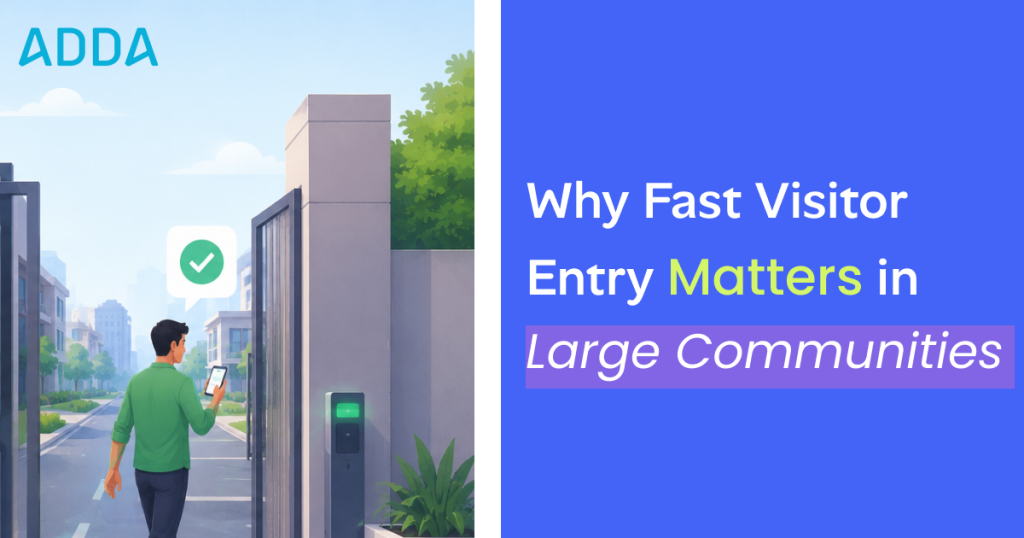
You’ve been there. You’re coming home after a long day, or maybe you’re just waiting for that 10-minute grocery delivery. You look out the window, and
There’s a line of bikes and cars snaking out of the main gate. The security guard isn’t doing anything suspicious; he’s just staring. Staring intensely at a smartphone screen that refuses to load.
The delivery partner is sighing. The guest in the car behind him are checking their watches. The resident is on the intercom, sounding frustrated. And the visitor app? It’s still “processing”.
It’s the 10-minute visitor entry that feels like a lifetime. When we talk about how to improve society gate security, the conversation usually revolves around cameras or taller fences. But the biggest vulnerability in a modern community isn’t a lack of tech. It’s slow, outdated technology that turns your main entrance into a bottleneck.
Table of Contents
Why is fast visitor entry important in housing communities?
Large communities are not just residential spaces anymore. They work like mini-cities.
A 500-unit or 1,000+ unit community may handle hundreds or even thousands of daily movements, including the following:
- Guests
- Delivery partners
- Cabs
- Housekeeping staff
- Drivers
- Vendors
- Parcels
- Service providers
- Maintenance teams
- Event visitors
For example, if a 1,000-unit community handles even 1,500 visitor, staff, delivery, and cab movements in a day, a delay of just 2 minutes per entry can create nearly 50 hours of waiting time at the gate in a single day.
That is why entry speed is not just about convenience.
It directly affects security, resident experience, staff productivity, and overall gate discipline.
What Happens When Visitor Entry Is Slow?
A slow gate system creates problems for everyone.
1. Gate Congestion Increases
When cars, bikes, and delivery partners start piling up outside the gate, the entry area becomes chaotic. In that confusion, unauthorized vehicles may slip in behind approved visitors.
This is commonly known as tailgating.
A good gate process should reduce this risk, not make it easier.
2. Guards Start Rushing
When guards see a long line of angry visitors and residents, they come under pressure. That pressure can lead to mistakes.
They may skip proper checks, miss details, or approve entries without enough verification.
Speed should not come by compromising security. The right visitor management software should help guards move faster while still following the right process.
3. Residents Get Frustrated
Residents do not want to answer repeated calls for expected visitors, deliveries, or regular staff.
If approvals are delayed or notifications are missed, residents start losing confidence in the gate system.
A visitor app should make life easier, not become another daily irritation.
4. Security Records Become Weak
In many communities, slow or unreliable systems force guards to fall back on phone calls, paper registers, or WhatsApp messages.
That creates scattered records.
And during a security incident, the Management Committee may struggle to answer basic questions like:
- Who entered?
- When did they enter?
- Who approved them?
- Why were they allowed inside?
- Was there any overstay or wrong entry?
A smart visitor management system should maintain clean digital logs for better accountability.
Why Many Visitor Management Systems Fail During Peak Hours
Many visitor management systems look good in demos. But the real test happens at the gate during rush hours.
Morning office time. School bus timings. Delivery peaks. Evening guest movement. Festival events. Vendor entries. Staff check-ins.
That is when weak gate systems start showing problems.
In many communities, visitor entry becomes slower because:
- Guards wait too long to fetch resident details.
- Visitor approvals are delayed when residents miss app notifications.
- Security teams fall back on manual phone calls.
- Too many clicks make the entry process slow.
- Pop-ups or promotions distract from gate work.
- Residents start ignoring alerts because the app feels noisy.
- Visitor movement is not recorded smoothly.
- The Management Committee loses confidence in the data.
A gate app should do one job really well:
Help every visitor entry happen faster, safer, and with complete focus.
Because at the gate, speed is not separate from security. It is part of security.
How ADDA GateKeeper Helps Large Communities Manage Visitor Entry Faster
In a large community, the gate is busy almost all day. Guests, cabs, delivery partners, staff, vendors, parcels — everything comes through the same point. That is why a visitor management system has to be fast, simple, and reliable for both residents and guards.
Here’s how ADDA GateKeeper makes that happen.
1. Pre-Approved Guest Entry
The fastest entry is when approval is done before the visitor reaches the gate.
With ADDA GateKeeper, residents can send invite links, QR codes, or OTP-based access to their guests in advance. When the visitor arrives, the guard simply verifies the details and completes the entry.
No repeated calls.
No long waiting.
No gate pile-up during peak hours.
This is especially useful for family visits, party guests, cab pickups, expected deliveries, and regular service providers.
2. Quick Approvals Through App, IVR, or Mobile Intercom
Not every visitor is planned. Sometimes the resident is driving, in a meeting, or simply misses the app notification.
ADDA GateKeeper gives residents multiple ways to approve visitors — through the app, IVR, or mobile intercom. If app approval is missed, the system can place an automated call, and the resident can approve by pressing a key.
So the guard does not have to manually call again and again, and the queue keeps moving.
3. Simple Workflow for Guards
At a busy gate, even a few extra seconds per visitor can create a long line.
ADDA GateKeeper keeps the guard workflow clean and fast. Visitor details, approval status, vehicle details, phone verification, and entry logs are all handled in one structured flow.
The guard does not have to depend on registers, WhatsApp messages, or memory. Every entry is recorded properly, even during delivery rush or evening peak hours.
4. Staff, Parcel, and Daily Movement Tracking
A smart gate system is not only for guests.
In large communities, househelp, cooks, drivers, housekeeping staff, vendors, and parcels move in and out throughout the day. ADDA GateKeeper helps track all of this in a more organized way.
Residents can get updates when their regular staff enter or leave. Guards can mark staff check-in and check-out. Blacklisted or restricted staff can be flagged at the gate.
For parcels, guards can maintain digital logs, residents get notifications, and OTP-based pickup helps avoid confusion or misplaced packages.
5. Real-Time Sync with Community Data
The gate should not work in isolation.
If a resident moves in, staff access changes, a parking detail is updated, or a restriction is added, the gate team should have that information without waiting for manual updates.
ADDA GateKeeper works with the larger ADDA ecosystem, so gate records stay connected with community data. This reduces errors, avoids confusion, and gives guards the right information at the right time.
6. Emergency Help, Patrolling, and Incident Reports
Security is not only about approving entries. It is also about responding quickly when something goes wrong.
ADDA GateKeeper supports Panic Alerts, guard patrolling, QR-based checkpoints, missed checkpoint alerts, and incident reporting with photos, voice notes, and location details.
This helps the management team track night rounds, security discipline, incidents, and recurring safety concerns with proper records instead of only verbal updates.
7. Audit Trails and Visitor Analytics
When there is a security issue, the first question is always simple:
Who entered, when, why, and who approved it?
ADDA GateKeeper maintains digital logs for visitors, staff, parcels, incidents, wrong entries, and overstays. This gives Management Committees proper reports and audit trails instead of scattered registers or guesswork.
8. Hardware Integrations for a Smarter Gate
Many large communities use boom barriers, biometrics, gate pass printers, and other access-control hardware.
ADDA GateKeeper can integrate with these systems, helping the community bring software and gate hardware into one connected workflow. This makes entry faster, cleaner, and easier for guards to manage.
9. Privacy-First, Zero-Ads Design
Visitor management involves sensitive data — resident names, flat numbers, visitor phone numbers, staff movement, parcel records, vehicle details, and entry history.
This data should stay protected.
ADDA GateKeeper follows a privacy-first, zero-ads approach. There are no third-party ads, no spammy promotions hidden as community updates, and no unnecessary misuse of resident or visitor data.
For Management Committees, this matters because the gate system is not just another app. It is part of the community’s security infrastructure.
How ADDA GateKeeper Improves the Resident Experience
A good visitor management system should make everyday life smoother for residents, guards, and management teams.
Here is how ADDA GateKeeper helps:
| Gate Problem | How ADDA GateKeeper Helps |
| Long visitor queues | QR/OTP-based pre-approved entry |
| Missed visitor approvals | IVR and mobile intercom backup |
| Guard confusion | Real-time sync with resident and staff data |
| Repeated phone calls | Structured approval workflows |
| Parcel confusion | Digital parcel logs and OTP pickup |
| Staff tracking gaps | Entry/exit logs, attendance, and alerts |
| Security blind spots | Patrolling, incident reports, and audit trails |
| App distractions | Zero-ads, focused gate workflow |
| Data privacy concerns | Privacy-first visitor management |
When the gate works well, residents feel the difference every day.
Guests enter without unnecessary waiting. Deliveries are tracked better. Staff movement is visible. Approvals are easier. Security records are reliable. And the app feels useful instead of noisy.
A good visitor management system does not just digitize the gate.
It makes the entire entry experience faster, cleaner, safer, and more trustworthy.
In Simple Words
Fast visitor entry is not just about reducing waiting time.
It is about building a safer and more organized community gate.
For large communities, a smart visitor management system should:
- Reduce gate queues
- Help guards work faster
- Give residents simple approval options
- Track visitors, staff, and parcels
- Support emergencies
- Maintain audit trails
- Connect with community data
- Protect resident and visitor privacy
That is what ADDA GateKeeper is built for.
Faster entry.
Stronger security.
Cleaner operations.
A more privacy-conscious community experience.
Want Faster Visitor Entry Without Compromising Security?
See how ADDA GateKeeper helps large communities reduce gate queues, manage approvals faster, and protect resident data.
Book an ADDA GateKeeper demo today
FAQs
Why does visitor entry speed matter in large communities?
Visitor entry speed matters because large communities handle hundreds or thousands of daily movements. Slow entry creates gate congestion, increases pressure on guards, delays residents and guests, and can make unauthorized entry easier during rush hours.
What is the best visitor management system for large housing complexes?
The best visitor management system for large housing complexes should offer fast visitor approval, QR or OTP-based pre-approved entry, IVR backup, staff tracking, parcel logs, audit trails, hardware integrations, and privacy-first data handling.
How can a housing society reduce gate queues?
A housing society can reduce gate queues by using pre-approved guest entry, faster guard workflows, real-time resident data sync, and backup approval options like IVR or mobile intercom.
How does IVR help in community visitor management?
IVR helps when residents miss app notifications or do not have active internet access. The system can place an automated call, and the resident can approve the visitor through a simple keypad response. This keeps the gate queue moving.
What problems do inefficient visitor apps create?
Inefficient visitor apps create delays, missed approvals, guard fatigue, resident frustration, poor visitor records, and weak security visibility. In large communities, these small delays can quickly turn into daily gate chaos.
What is a privacy-first visitor management system?
A privacy-first visitor management system protects resident, visitor, staff, parcel, and vehicle data. It does not use the gate system to push ads, spam residents, or share sensitive information with third parties.
Can visitor approval work when the resident’s internet is not active?
Yes. With ADDA GateKeeper, IVR-based approval can help residents approve visitors through an automated phone call when app notifications are missed or internet connectivity is poor.